
You’ve probably heard about the telegraph before, but did you know the story of how it came to be? It all started because the long-distance messaging system at the time was too slow. For example, it took 12 days for a message to go from London to New York and 73 days for a message to go from London to Australia. Samuel Morse was a skilled painter whose wife had become ill, and by the time he received the news, she had already passed away and been buried. This caused him to change his profession from painter to inventor, where he sought to create a better communication system.
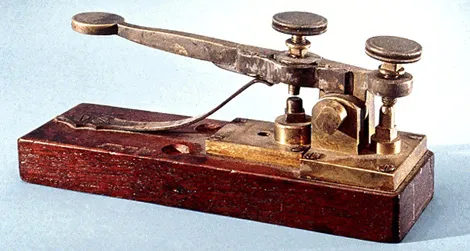
Originally, the telegraph was limited by current technology, but it became possible with the invention of the Tesla coil and the electromagnet. He also had to convince people to invest in his idea by making them believe that it would be commercially viable. By 1838, Morse had developed the first telegraph, a point-to-point messaging device that sent beeping sounds from the sender to the receiver. The beeps could be interpreted as “dots” or “dashes,” representing different letters, numbers, and symbols based on the order in which they were sent. There was no standard set for how long a dot or dash was, except that a dash was the length of three dots and a space between letters was a pause the length of one dot.
The first official Morse code message transmitted in the U.S. was sent by Morse himself, saying “What hath God wrought” in 1844, which became famous. The telegraph grew fairly quickly after this; the first transatlantic cables were set up in 1858, and by 1861, telegraph wires were running across the entire U.S. Because of their usefulness, telegraphs became very important in wars, and the messages needed to be encrypted to prevent the enemy from intercepting them and gaining an advantage. Before the Civil War, there were 300 miles of telegraph wire in the U.S.; this number grew to 1,500 miles by the end of the war.
Although telegraphs were very popular at the time, they quickly became an irrelevant technology. The leading telegraph company, Western Union, had heard that the Bell Telephone Company was going to install telephones in everyone’s homes but didn’t think it would be possible. Unfortunately for them, it was possible, and by the 1870s, the telephone had been invented and quickly replaced the telegraph.
Spelling Check
Prompt:
Correct any spelling, grammar, or punctuation error in the following text: You’ve probably heard about the telegraph before, but did you know the story of how it came to be? It all started because the current long-distance messaging system at the time was too slow. For example, it took 12 days for a message to go from London to New York and 73 days for a message to go from London to Australia. Samuel Morse was a skilled painter whose wife had become ill and by the time he received the news, she had already passed away and been buried. This caused him to change his profession from painter to inventor where he sought to invent a better communication system.
Originally, the telegraph was limited by current technology, but it became possible with the invention of the Tesla coil and electromagnet. He also had to convince people to invest in his idea by making them believe people would buy it. By 1838, Morse had made the first telegraph, a point-to-point messaging device that sent beeping noises from the sender to the receiver. The beeps could be interpreted as “dots” or “dashes, ” representing different letters, numbers, and symbols based on the order they were sent. There was no time standard set for how long a dot or dash was except that a dash was the length of three dots and a space between letters was a pause the length of one dot.
The first official Morse code message transmitted in the US was sent by Morse saying “What hath God wrought” in 1844 and became famous. The telegraph grew fairly fast after this and the first transatlantic cables were set up in 1858 and by 1861 telegraph wires were running across all of the US. Because of their usefulness, they became very important in wars and the messages needed to be encrypted to prevent the enemy from intercepting the message and gaining an advantage. Before the Civil War, there were 300 mi of telegraph wire in the US; this number grew to 1500 mi by the end of the war.
Although telegraphs were very big at the time, they quickly became an irrelevant technology. The leading telegraph company, Western Union had heard that the Bell Telephone Company was going to put telephones in everyone’s homes but didn’t think it would be possible. Unfortunately for them, it was possible and in the 1870s the telephone had been invented and quickly replaced the telegraph.
Response:
Here’s a corrected version of your text with adjustments for spelling, grammar, and punctuation:
—
You’ve probably heard about the telegraph before, but did you know the story of how it came to be? It all started because the long-distance messaging system at the time was too slow. For example, it took 12 days for a message to go from London to New York and 73 days for a message to go from London to Australia. Samuel Morse was a skilled painter whose wife had become ill, and by the time he received the news, she had already passed away and been buried. This caused him to change his profession from painter to inventor, where he sought to create a better communication system.
Originally, the telegraph was limited by current technology, but it became possible with the invention of the Tesla coil and the electromagnet. He also had to convince people to invest in his idea by making them believe that it would be commercially viable. By 1838, Morse had developed the first telegraph, a point-to-point messaging device that sent beeping sounds from the sender to the receiver. The beeps could be interpreted as “dots” or “dashes,” representing different letters, numbers, and symbols based on the order in which they were sent. There was no standard set for how long a dot or dash was, except that a dash was the length of three dots and a space between letters was a pause the length of one dot.
The first official Morse code message transmitted in the U.S. was sent by Morse himself, saying “What hath God wrought” in 1844, which became famous. The telegraph grew fairly quickly after this; the first transatlantic cables were set up in 1858, and by 1861, telegraph wires were running across the entire U.S. Because of their usefulness, telegraphs became very important in wars, and the messages needed to be encrypted to prevent the enemy from intercepting them and gaining an advantage. Before the Civil War, there were 300 miles of telegraph wire in the U.S.; this number grew to 1,500 miles by the end of the war.
Although telegraphs were very popular at the time, they quickly became an irrelevant technology. The leading telegraph company, Western Union, had heard that the Bell Telephone Company was going to install telephones in everyone’s homes but didn’t think it would be possible. Unfortunately for them, it was possible, and by the 1870s, the telephone had been invented and quickly replaced the telegraph.
—
Let me know if you need anything else!