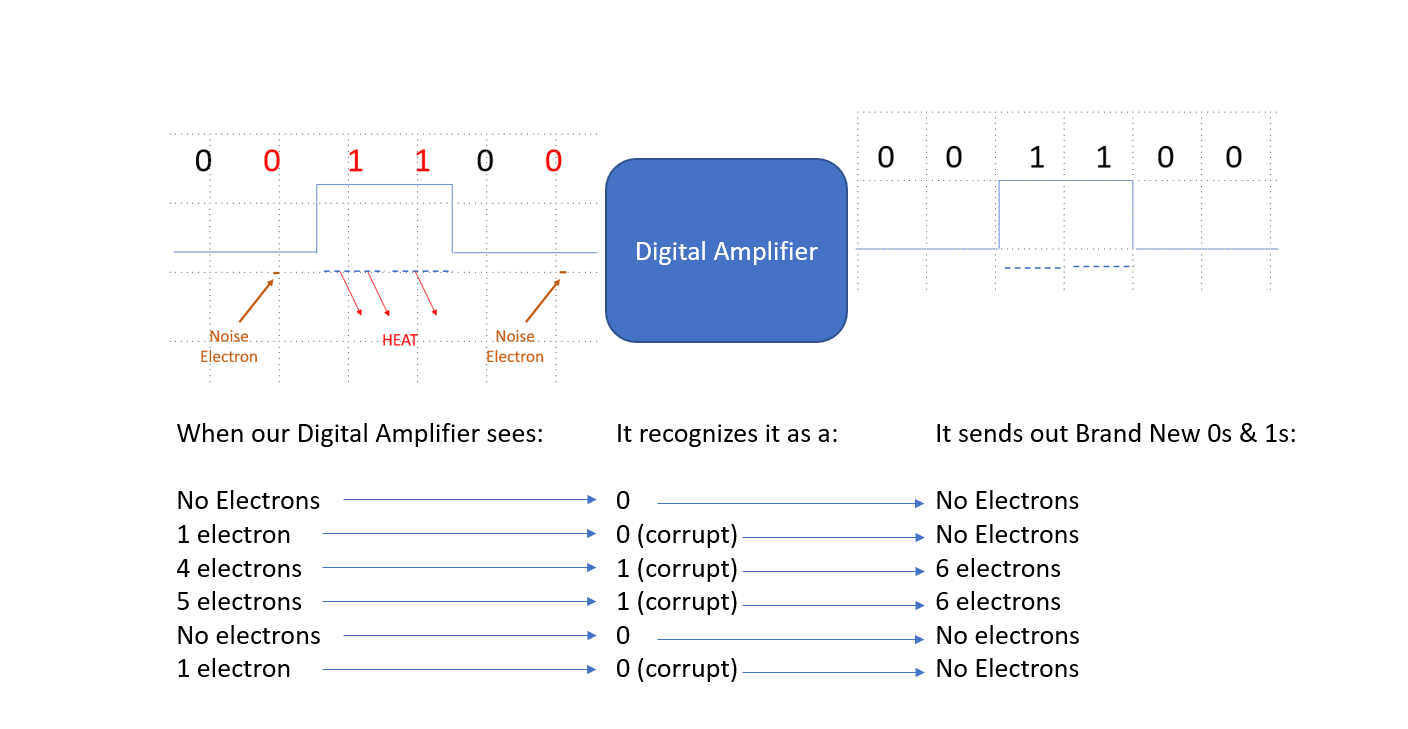
Digital technology has replaced analog due to its ability to resist noise, maintain signal quality, and process data efficiently. Unlike analog systems, which degrade over time due to interference, digital signals (represented by 0s and 1s) can be easily corrected. As shown in the diagram, a digital amplifier can “clean” corrupted signals, restoring them to their original state by recognizing them as either 0 or 1. This allows digital signals to be transmitted over long distances without loss of quality. Additionally, digital data can be stored, processed, and transmitted more efficiently, making it ideal for modern applications like communication, media, and computing. This resilience and versatility are key reasons digital technology has largely replaced analog systems.